Category: Book releases

Books authored by Andrew C. Phiri

The Seventh Persecution, under Decius, 249 AD

Numerous persecutions took place during the reign of Decius. There was a vehement desire to exterminate Christians. One account of persecution involved chastity and unwavering faith in the face of seduction.

Beautiful but chaste Agatha

 It is the story of Agatha, a very beautiful woman who lived in Sicily. The governor of Sicily, Quintian, got so attracted to Agatha’s beauty that he made several attempts to be in love with her but it was to no avail. Next he conspired with Aphrodica, a promiscuous woman, to lure Agatha into an immoral life.

Aphrodica tried all she could to influence Agatha into prostitution but she failed. The evil conspirators could not understand the impregnable discipline and chastity of this attractive virgin. Unknown to them was the power of the Gospel in her heart which kept her from sin. That’s how a true believer is consecrated; he or she remains faithful even when sin becomes so attractive or luring. It is not so with some professed believers: they appear clean and innocent not because that’s what they truly are but because they haven’t had an opportunity to sin secretly, where no man can see them!

Quintian became frustrated over his failure to have Agatha. His lust turned into anger and resentment. When Agatha confessed she was a Christian Quintian  found an opportunity to frustrate and persecute her. Events that followed next, in Agatha’s life, was horrendous.

Agatha had her breasts cut. She was stripped naked and thrown on hot coals of fire which were mingled with glass. She was later taken to prison where she died on 5th February, 251 AD.

Soldiers defy an Order

In the same year Agatha died the emperor, Decius, ordered the people of Ephesus to offer sacrifices to idols in a pagan temple he had erected. Strangely, seven of his soldiers defied the order. This was not good for the emperor: their refusal clearly testified of the growing influence of Christianity. He decided to give them time to reconsider. He proceeded to attend an expedition giving the soldiers time to reflect on the grave offence they committed. However, after he left the soldiers escaped and went into hiding in a large cave. On his return the emperor was informed about the matter and the whereabouts of the soldiers. He ordered for the mouth of the cavern to be closed up with a huge stone. There the soldiers perished with hunger.

Origen the Theologian and Apologetic

Origen, known as “the greatest genius the early church ever produced”[1] taught  logic, cosmology and natural history. Although some of his teachings were controversial and considered heretic, he was a Christian scholar, theologian and apologetic[2] whose writings established fundamental principles of theology. Christian churches in  Palestine and Arabia regarded him as the ultimate authority on all matters of theology.

Famous writings of Origen include On The First Principles, Contra Celsum, and the Hexapla. In On the First Principles Origen established the fundamental principles of Christian theology. This became a very important work for Christian scholars. Contra Celsum  was a defense of Christianity against the pagan philosopher Celsum. In Origen Celsus met a mind that could challenge his wit. Thus, Contra Celsum became the most important reference work for early Christian apologetics. Hexapla  is a large volume of the Bible consisting of six columns. The columns compare the different languages into which Scripture was written. There is a column with the Hebrew text, another column with the Greek transliteration of it, and four other Greek versions of Aquila, Symmachus, and Theodotion, and a revised version of the Septuagint.

At the age of 64, in 250 AD, Origen fell in the hands of the persecutors. He got arrested and was so severely tortured. John Foxe wrote that Origen was “thrown into a loathsome prison, laden with fetters, his feet placed in the stocks, and his legs extended to the utmost for several successive days. He was threatened with fire, and tormented by every lingering means the most infernal imaginations could suggest.” It so happened that the Emperor Decius died around this time. His successor, Gallus, was engaged in a war which took some attention away from persecuting Christians. Origen retired to start living in Tyre where he shortly died from injuries he suffered from the tortures.

>The Eigth Persecution


[1] McGuckin, J.A. (2004). The Westminster Handbook to Origen. Louisville, Kentucky: Westminster John Knox Press.

[2] An apologetic is a person who provides a formal or logical defence or justification for a belief or doctrine.

The Sixth Persecution, under Maximus, 235 AD

During the time of Emperor Maximus “numberless Christians were slain without trial, and buried indiscriminately in heaps, sometimes fifty or sixty being cast into a pit together, without the least decency.” Maximus was succeeded by Gordian  “during whose reign, and that of his successor Philip, the Church was free from persecution for the space of more than ten years.” However, the terrible beast was not yet satisfied with the blood of martyrs. More persecution was yet to happen.

>The Seventh Persecution

Fifth Persecution, commencing with Severus, 192 AD

Some records indicate that Emperor Severus was kind towards Christians, and others present him as a persecutor. Tertullian for example writes about Severus employing a Christian as his personal physician. However, during his reign many persecutions occurred which historians like Eusebius have attributed to him.

Among the Christians killed during this time was the renowned teacher of the Word and preacher against heresy –  Irenaeus, bishop of Lugdunum (this place is situated in France and is now called Lyon). Irenaeus originated from Smyrna (the place is now called Izmir in Turkey). He was mainly influenced by ministry of Polycarp, who was in turn a disciple of apostle John, scribe of the book of Revelation. Irenaeus wrote the famous work, Against Heresies, in which he taught against heretical teachings of Gnosticism. He admonishes a believer to base his faith on Scripture and traditions of the apostles and their successors. Irenaeus’ ‘war’ against heretics made him noticeable before roman authorities. In 202 AD he was beheaded.

Another account of martyrdom that brings sorrow to the heart occurred in Africa. It involved some Christian women – Perpetia, Felicitus, Revocatus, Saturninus, Secundulus, and Satur.

Saturninus, Revocatus, and Satur were made to run between two rolls of armed men. They were severely injured as they passed.

Felicitus was heavy with child (she was pregnant). Together with  Perpetua they were stripped naked and then thrown to a mad bull. The bull first attached Perpetua. She lay unconscious dying. It then darted at Felicitus and gored her dreadfully. The executioner then used his sword to kill the two Christian women. All this happened on 8th March, 205 AD.

> The Sixth Persecution

The Fourth Persecution, under Marcus Aurelius Antoninus, 162 AD

The sight of cruelties suffered by Christians became too much to behold by spectators. At the writing of these words, as I read through the account of the fourth wave of persecutions, I shuddered with disgust and anger:

Some of the martyrs were obliged to pass, with their already wounded feet, over thorns, nails, sharp shells, etc. upon their points, others were scourged until their sinews and veins lay bare, and after suffering the most excruciating tortures that could be devised, they were destroyed by the most terrible deaths. 

Polycarp, the bishop of Smyrna, the church to which the Lord Jesus had sent these prophetic words –  “Fear none of those things which thou shalt suffer: behold, the devil shall cast some of you into prison, that ye may be tried; and ye shall have tribulation ten days: be thou faithful unto death, and I will give thee a crown of life” (Rev.2:10) – had this to answer to his tormentor who had offered him freedom if he denounced Christ: “Eighty and six years have I served him, and he never once wronged me; how then shall I blaspheme my King, Who hath saved me?”

> The Fifth Persecution

Third Persecution, under Trajan, 108 AD

During the third persecution, Pliny the Younger, a magistrate, wrote to emperor Trajan, pleading that Christians did not deserve the atrocities committed against them. He explained that thousands of Christians were daily killed despite having never broken any Roman law. “The whole account they gave of their crime or error (whichever it is to be called) amounted only to this… that they were accustomed on a stated day to meet before daylight, and to repeat together a set form of prayer to Christ as a God, and to bind themselves by an obligation–not indeed to commit wickedness; but, on the contrary–never to commit theft, robbery, or adultery, never to falsify their word, never to defraud any man: after which it was their custom to separate, and reassemble to partake in common of a harmless meal.”

The words of Pliny brings these words of Christ to memory: “And this is the condemnation, that light is come into the world, and men loved darkness rather than light, because their deeds were evil” (Joh.3:19).

Now despite all the cruel persecutions Christians suffered, their courage was most astonishing. The testimony of Ignatius, successor of apostle Peter’s work to oversee churches in Antioch, is most warming to the heart. In his letter to believers in Rome, he admonished: “Now I begin to be a disciple. I care for nothing, of visible or invisible things, so that I may but win Christ. Let fire and the cross, let the companies of wild beasts, let breaking of bones and tearing of limbs, let the grinding of the whole body, and all the malice of the devil, come upon me; be it so, only may I win Christ Jesus!” When he was thrown to the lions and he heard their roar, he proclaimed: “I am the wheat of Christ: I am going to be ground with the teeth of wild beasts, that I may be found pure bread.”

The faith and bravery of these martyrs in death was so great that it converted some pagans. It so happened one day that a pagan was so touched beholding the death of martyrs that he exclaimed, “Great is the God of the Christians!” For this  he was apprehended and killed.

Trajan was succeeded by Adrian who continued the persecutions. Adrian died in 138 AD and was succeeded by Antoninus Pius. This new emperor did not persecute Christians. His reign was peaceful.

>The Fourth Persecution

Second Persecution of Christians, under Domitian, 81 AD

Domitian started the second persecution against Christians. During his reign a law was passed that said “no Christian, once brought before the tribunal, should be exempted from punishment without renouncing his religion.” It was during this time that false superstitious beliefs were made up in Roman Society, all for the purpose of persecuting Christians: people believed that  famine, earthquakes, and pestilence were to be blamed on Christians!

It was during the Domitian Persecution that apostle John, writer of the book of Revelation was boiled in oil and then banished to the island of Patmos. Timothy, a disciple of Paul and bishop of Ephesus, was also killed in 97 AD. It so happened that one day Timothy met a procession of pagans who were celebrating the feast of Catagogion. During this feast people carried various images (idols) of gods they worshipped. Timothy got enraged and so severely rebuked the pagans of their stupid idolatry. The angry mob of pagans descended on Timothy, injuring him with clubs. Timothy was so badly injured and  bruised that he died two days later.

Other notable Christians who died during the Domitian Persecution include Simeon the bishop of Jerusalem, and Protasius and Gervasius.

> The Third Persecution

First Persecution of Christians, under Nero, 67 AD

Note: although the prophecy of Daniel presents the “little horn” as the persecutor of saints, It actually was only continuing what had already begun by the beast-system, way before the rise of the “ten horns” on the head of the beast. Pagan Rome was so ruthless and had no regard for human life. Killing was sport. Christians suffered during the Roman Empire. Fox’s Book of Martyrs chronicles the savagery murders. The accounts are so gruesome that one wonders how humans endured such extreme torture!

The first great persecution of Christians began in the year 67AD during the reign of  Nero, the sixth emperor of Rome. Fox’s Book of Martyrs records that “this monarch reigned for the space of five years, with tolerable credit to himself, but then gave way to the greatest extravagancy of temper, and to the most atrocious barbarities.”

The madness in Nero desired chaos during his reign. He was once heard publicly declaring that he wished the ruin of all things before his death. He was so determined to this end that he ordered his officers to set  the city of Rome on fire. However, this inferno caused a widespread anger and disgust among Romans. Nero excused himself by blaming the inferno incident on Christians and that initiated the great persecution.

Nero even refined upon cruelty, and contrived all manner of punishments for the Christians that the most infernal imagination could design. In particular, he had some sewed up in skins of wild beasts, and then worried by dogs until they expired; and others dressed in shirts made stiff with wax, fixed to axletrees, and set on fire in his gardens, in order to illuminate them. This persecution was general throughout the whole Roman Empire.

It was in the course of this great persecution that apostles Peter and Paul were martyred.

> The Second Persecution

Fourth Beast – Dreadful and Terrible

The winds continued striving over the great sea as the fourth beast, that blood-thirsty empire – Rome, began to rise. Its tenacity and ruthless reign was incomparable to any known predator beast and hence this beast was only depicted as a dreadful and terrible beast in the vision of Daniel:

7 After this I saw in the night visions, and behold a fourth beast, dreadful and terrible, and strong exceedingly; and it had great iron teeth: it devoured and brake in pieces, and stamped the residue with the feet of it: and it was diverse from all the beasts that were before it; and it had ten horns.

Notice this description of the beast –  “diverse from all the beasts.” The word for “diverse” in Chaldean, the language Daniel used to write this vision, is shena and means to alter or change. This was exactly the case with the fourth empire: Rome unlike other kingdoms evolved into different forms over time. From a monarch system, to a republic, and then an empire. From a pagan empire to a Christian one! As Daniel looked at the terrible beast, its ten horns got his attention. Something was happening to three of the ten horns:

8 I considered the horns, and, behold, there came up among them another little horn, before whom there were three of the first horns plucked up by the roots: and, behold, in this horn were eyes like the eyes of man, and a mouth speaking great things.

A strange vision it was, but thankfully, we don’t have to wonder about its meaning because the interpretation was already given to Daniel (see  verses 23-25 below). Events in the vision of Daniel took a different turn after he saw the little horn plucking up three horns. Daniel saw “thrones” (i.e. the political powers or kingdoms of the world) being cast down.

9 I beheld till the thrones were cast down…

This had been shown to Nebuchadnezzar in a dream as “the stone” breaking in pieces “the iron, the brass, the clay, the silver, and the gold”, metals which Daniel had interpreted to represent the four world empires.

All the empires of the world felt great in their time. The kings of the empires had established their thrones. However, as Nebuchadnezzar had later come to learn, there has always been the greater ‘throne’ (power) above, where the true king ‘sits’ – “Now I Nebuchadnezzar praise and extol and honor the King of heaven, all whose works are truth, and his ways judgment, and those that walk in pride he is able to abase” (Dan.4:37).

Unlike earthly thrones which come and go, the throne of the “King of heaven” is established forever. The judgments of this “King” are righteous and wise.

On earth we esteem men who have lived longer to be wiser – “Days should speak, and multitude of years should teach wisdom” (Job 32:7, cf. Pro.16:31). But there is One who inhabits eternity and hence the source of all wisdom (Isa.57:15); He is God and was rightly called “the Ancient of Days” in Daniel’s vision. Although no one can or has ever seen God (Joh. 1:18), and although He dwells “in the light which no man can approach unto;  whom  no man hath seen, nor can see” (1 Tim.6:16), Daniel had to be shown a symbol of something that he could write for you and I to be able to read it. Thus he saw:

9…and the Ancient of days did sit, whose garment was white as snow, and the hair of his head like the pure wool: his throne was like the fiery flame, and his wheels as burning fire.

The vision next showed the setting of the day of judgment of nations:

10 A fiery stream issued and came forth from before him: thousand thousands ministered unto him, and ten thousand times ten thousand stood before him: the judgment was set, and the books were opened.

The judgment mentioned in verse 10 above will not be done directly by the invisible God (Yahweh), and neither will it occur in heaven. The judgment will be executed through a human vessel (see verse 13 notes below).

In verse 11 Daniel’s attention is taken back to the little horn he had seen earlier. He is shown the judgment that would occur to the beast on which the little horn was because of the blasphemous words it had uttered. Daniel also notices that although the previous beasts had their dominion taken away (at the time when they fell and gave way to other empires in history), their “lives” ­ – spirit or influence – had prolonged  for a season:

11 I beheld then because of the voice of the great words which the horn spake: I beheld even till the beast was slain, and his body destroyed, and given to the burning flame.

12 As concerning the rest of the beasts, they had their dominion taken away: yet their lives were prolonged for a season and time.

What we see in the following two verses (13 and 14) is a human vessel that God would manifest through to judge the nations and to establish  a new kingdom on earth. This human vessel already came to earth, ascended to heaven and we await his return. He was not an ordinary human being but the visible manifestation of the invisible God in human flesh (1 Tim.3:16), a God-man!  That was none other than the Lord Jesus Christ (Joh.1:14).

Jesus is not another God; He is not one-third of the so-called Trinity  for “in Him dwelleth all the fullness of the Godhead bodily” (Col.2:9). He will one day return to come and establish the Kingdom of God on earth. This kingdom shall never fall to another empire for nations will not war against another; the earth shall be full of the knowledge of God, and in righteousness and peace Christ shall rule the world (Isa.11:5,9):

13 I saw in the night visions, and, behold, one like the Son of man came with the clouds of heaven, and came to the Ancient of days, and they brought him near before him.

14 And there was given him dominion, and glory, and a kingdom, that all people, nations, and languages, should serve him: his dominion is an everlasting dominion, which shall not pass away, and his kingdom that which shall not be destroyed.

As Daniel saw these visions, he got so troubled about the meaning of the details of the fourth diverse beast and its little horn which had plucked three other horns. He narrated his grief and perplexity in verse 15 through 22:

15I Daniel was grieved in my spirit in the midst of my body, and the visions of my head troubled me.

16I came near unto one of them that stood by, and asked him the truth of all this. So he told me, and made me know the interpretation of the things.

17These great beasts, which are four, are four kings, which shall arise out of the earth.

18But the saints of the most High shall take the kingdom, and possess the kingdom for ever, even for ever and ever.

19Then I would know the truth of the fourth beast, which was diverse from all the others, exceeding dreadful, whose teeth were of iron, and his nails of brass; which devoured, brake in pieces, and stamped the residue with his feet;

20And of the ten horns that were in his head, and of the other which came up, and before whom three fell; even of that horn that had eyes, and a mouth that spake very great things, whose look was more stout than his fellows.

21I beheld, and the same horn made war with the saints, and prevailed against them;

22Until the Ancient of days came, and judgment was given to the saints of the most High; and the time came that the saints possessed the kingdom.

The Lord was gracious and revealed to Daniel more details about the fourth beast and its little horn:

23Thus he said, The fourth beast shall be the fourth kingdom upon earth, which shall be diverse from all kingdoms, and shall devour the whole earth, and shall tread it down, and break it in pieces.

24And the ten horns out of this kingdom are ten kings that shall arise: and another shall rise after them; and he shall be diverse from the first, and he shall subdue three kings.

25And he shall speak great words against the most High, and shall wear out the saints of the most High, and think to change times and laws: and they shall be given into his hand until a time and times and the dividing of time.

The feature of being “diverse” was so prominent about this beast that it is was again stated in the interpretation of the vision by the angel. To appreciate the diverse nature of the Roman Empire let us look into its history.

History of Rome

Alexander’s conquests had progressed eastwards. He never took interest in the region that lay west. It is important to know that at the time of Alexander’s exploits, the western region only consisted of a few Greek colonies and was clustered with  wooded peninsulas which were populated with peasants.

The peasant tribes were stubborn, unruly, and ready to defend themselves in case of any invasion. One such tribe were the Romans who occupied a peninsula called Italy.

Rome has had a diverse history which can be categorized as follows:

  • The period of kings
  • The period of the Republic when two Consuls were voted into office by the Senate.
  • The period of emperors, which can be further divided into two epochs as Pagan Roman Empire and Holy Roman Empire.

Before we look at the above diverse nature of Roman history, it is important to know that roman society was generally characterized by two kinds of people – the patricians and the plebeians.

Plebeians (or plebs in short) were the common or poor people that formed much of the citizenry of roman society. Patricians comprised families which owned vast estates and meadows; they were the noblemen of society. It was out of the patricians that men entrusted with the task of appointing a leader came. This council of leaders was called the senate.

1. Roman Monarch  – Period of Kings

Like many ancient tribes Romans had myths and legendary stories about their origins. The Romans traced their origins to the renowned twin brothers, Romulus and Remus. The twins were believed to be sons of Mars, suckled and raised by a wolf!

The planet Mars was worshipped as a god of war by Romans. They believed that in time of war Mars would come to their aid and so it became a practice during war to offer prayers to Mars.[1] So, how greatly to be revered were the sons of Mars!

Romulus later killed Remus and established himself as the first king of Rome in 753 BC. There were six other kings who rose after Romulus. There are interesting details in the histories of these kings that will be important to understanding certain details of the prophecy of Daniel. So let us briefly go through what happened during this early history of Rome.

I. Romulus

As earlier mentioned, the rise of Romulus to power as a king is believed to have been in 753 BC. The reign of Romulus was not characterized by peace. It was full of conflict and war with other tribes in the region. Romulus is believed to have died in 648 BC. He was succeeded by Numa Pompilius.

II. Numa Pompilius

The new king, Numa Pompilius, compared to Romulus, was very different in character and in the manner he ruled Rome. He was peaceful and very religious. He built religious institutions (colleges and the famous Temple of Janus).

It is Numa Pompilius who added January and February (two more months) to the calendar so that a year now consisted of 12 months![2] Note that previously, during the time of Romulus, a year consisted of 360 days. The calendar system had different number of days. Some months had more or less days than others. Numa “estimated the solar year at 365 days and the lunar year at 354 days. He doubled the difference of eleven days and instituted a leap month of 22 days to come between February and March …[He] put January as the first month, and may indeed have added the months of January and February to the calendar” (Bingley, 2017).

Numa died in 673 BC. A new king ascended to power.

III. Tullus Hostilius

This was the third king of Rome. Tullus was very unlike his predecessor – he was warlike and not religious.

Tullus was much like Romulus: “Both Tullus and Romulus supposedly carried on war with the neighbouring cities of Fidenae and Veii, doubled the number of Roman citizens, organized the army, and disappeared from earth in a storm” (Britannica Encyclopaedia, 2017). Concerning his ‘disappearance’, Tullus is said to have been struck by a lightning and reduced to ashes. The year was 642 BC.

IV. Ancus Marcius

Ancus is said to have been the fourth king of Rome. In trying to avoid  problems of the previous king (which resulted from  his earlier neglect of religion but for which he later tried to amend his ways by giving heed to the desires of the gods by giving reverence to them), after becoming king he focused on ensuring that religious rites were given their important place in society and were done correctly. To this end he ordered Pontifex Maximus[3] to publicly publish words which provided guidelines on how public religious festivals were to be performed.

At this juncture it is important to point out that in the early history of Rome ascendancy to the throne was not through ancestry. Rather, a popular or influential person would be acclaimed to the throne. Thus, although Ancus had sons at the time of his death,  a popular man by the name Lucius Tarquinius Priscus, had managed to influence people to let him become the next king.

V. Lucius Tarquinius Priscus

Lucius Tarquinius Priscus or Tarquin the Elder is said to have been the fifth king of Rome, and scholars estimate that he must have reigned from 616 to 578 BC.

Tarquin had much interest in sport and he gave it much importance in Roman society. He is said to  have built the  the first and largest stadium at Rome.

The stadium was constructed and organized in style: there was a raised seating platform for political leaders and other prominent people. There were also other sections reserved for other  private citizens.

Tarquin also introduced forms of insignia that distinguished officials and military authorities. The different forms of insignia introduced includeed  the sceptre of the king; a purple garment or mantle called the trabea;  a special chair (curule chair ) on which rulers, magistrates, and other men of authority would seat (the chair became a symbol of power); and the rings worn by senators. It is interesting to note that these carnal Roman practices later found themselves in the Christian Church system where leaders of the clergy would wear special kinds of clothing with sceptres that distinguished them from members of the laity! A true church of God consists of brothers and sisters whose only clothing is that of humility, and their sceptre of authority is the Word of God!

Tarquin the elder is believed to have been assassinated by children of Ancus Marcius (his predecessor) in 579 BC.  The children believed that they were the ones to succeed their father.

VI. Servius Tullius

Servious Tullius ruled from 575-535 BC.  He was very popular with people and  is said to have been the first king of Rome to accede without election by the senate. During his reign he improved the living standards of many plebeians.

Servius was a religious man who is known to have built temples to the god Fortuna and goddess Diana. Fortuna in Rome was the god of luck or fortune, and Diana was a goddess over hunting and nature. The goodness Diana was believed to give power to control and speak to animals.

Servius is also credited for the introduction of silver and bronze coins in Rome. However, there are no facts to support this.

Servius ruled for 44 years and was assassinated by his daughter in connivance with her husband, Lucius Tarquinius Superbus.

VII. Lucius Tarquinius Superbus

The reign of Lucius Tarquinius Superbus  is dated from 534 to 509 BC. Tarquinius was an extremely proud and arrogant ruler and hence his nickname “Superbus” which means “proud”; he is actually usually referred to as Tarquin the Proud. Later on people could not bear his rule of tyranny and one, a noble man called Brutus, assassinated him. After Tarquin the Proud power was never to be in the hands of a king but two elected officials from the senate. Thus ended the period of the kings, giving way to the birth of the Roman Republic.

2. Roman Republic – Rule by Consuls

During the period of kings the Senate had only worked as an advisory council to the king, but with the founding of the republic by Lucius Junius Brutus, the man who killed Rome’s last king, it gradually grew into a powerful institution.

During the republic two officials, called Consuls, were elected by the Senate to rule Rome. As was stated earlier, the people with the privilege to voice opinion and to vote for a consul were the rich patricians. Plebeians were poor and not recognized in matters of governance. However, they were greater in number, strong-willed, and very stubborn. They increasingly became dissatisfied with the unjust system. They began to struggle for recognition. This was occurring during the time of Alexander the Great. The struggle of plebeians persisted for centuries until they prevailed to have one of the two consuls a plebeian.

During the early years of the republic, Rome only used to war with its small neighboring towns. But after the time of Alexander the Great, there was a growing desire to overcome and subdue the entire Italian peninsula. But this would not be an easy task as Grecian forces were still a power to reckon with.

One day a squadron of Roman ships  arrived at the coast of Tarentum, a wealthy Greek colony (see Fig.2 for map). This violated a treaty with the Tarentines which forbade Rome to sail on the coast. The Tarentines sunk five of the ten ships of Romans. Rome was infuriated and declared war on the Greek colony. Tarentum called for assistance from a Greek prince called Pyrrhus. In 280 BC the Pyrrhic War began.

Pyrrhic War

Pyrrhus was a skillful commander. His armies fought the Romans using elephants. They had learned using elephants from Indians. The Romans had no experience fighting warfare. They lost the initial war. However, the victory of Pyrrhus was at such a great cost (it is from this that a phrase ‘Pyrrhic victory’ was coined – a victory won at great cost).  In the course of the war he was fast running out the much needed man-power to replenish and augment his army. The Romans on the other hand had readily available manpower which always quickly replaced depleted forces.

Tired of fighting the ever-persistent Romans, Pyrrhus withdrew his forces.

The withdrawal of Pyrrhus’ army gave the Romans a leeway to take over the whole southern Italy! But the Romans were not satisfied, they also wanted Sicily, an island which yielded good crops because of its rich fertile soil (see location of Sicily on map below). However, there was a great stumbling block to acquiring this productive city – a nearby mighty city of Phoenicians called Carthage which controlled Sicily.
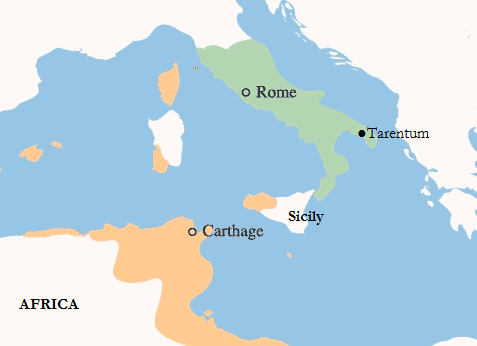
sicilyyy.png

Fig.2 Tarentum, Sicily, and Carthage

Rome decided to take the risk of fighting the Punics. But again, like they suffered losses in the Pyrrhic war because of their unfamiliarity with warring elephants, in the war with Punics they encountered an enemy skilled with what they were almost totally ignorant about –  sea warfare (facilitated by ships).

Punic Wars – Sicily and Carthage “stamped”!

The ships of Punics were many and well built. Romans were unaccustomed to voyages and didn’t have a well-established ship-building industry. But Rome had the persistent iron strength (as shown in Daniel’s vision) which would soon stamp (not only Sicily but) Carthage itself under its feet! And once under its feet, a people’s autonomy and identity would be crashed underneath the brazen claws of Rome.

The first war between Romans and Carthagians, often referred to as the First Punic War, occurred between 264 and 241 BC. The Romans emerged victorious and managed to annex Sicily. With the loss of Sicily Carthagians sought to occupy Spain. In Spain was a skilled Carthagian commander called Hannibal who was so angry at the humiliation Carthage had suffered by the Romans. He desired to destroy Rome at whatever cost!

Hannibal’s anger against Rome led to the  Second Punic War between 218 and 202 BC, rated as one of the deadliest in history! Hannibal decided to march from Spain and fight the Roman Republic on their homeland in Italy. But how would such a feat be accomplished when Rome controlled the Sea and had impregnable defense forces across coastal roads? He ordered his army to do the undoable  – to march through southern France, moving over the rivers, wild mountains and over to the Alps, and finally into Italy! Romans never thought an army commander would take such an extreme risk.

Hannibal_route_of_invasion-en.svg.png

Fig. 3 Hannibal’s route of Invasion

Enroute to Italy Hannibal’s troops crushed with Roman armies at Trebia in 218 BC. The following year in 217 BC he again defeated the Romans at Lake Trasimene. As his troops marched southwards in Italy, in 216, he crashed with Romans at Cannae and there he annihilated their largest army ever assembled! Rome was on the verge of destruction as most of its allies defected to fight with Hannibal. Despite this remarkable victory, however, when Rome was within his grasp, Hannibal surprisingly hesitated to move on and take over Rome. He waited for more reinforcements from Carthage and that was his undoing! In the meantime Rome restrategised.

The Roman general Quintus Fabius Maximus, avoided to engage with Hannibal in war. Instead Rome would take on Hannibal’s allies. A troop sent from Carthage to reinforce Hannibal was intercepted and defeated in 207 BC. Rome recaptured all cities that had defected to Carthage. Publius Cornelius Scipio, a Roman general led his army into a series of victorious battles against Carthagians. In 206 BC he destroyed a Carthagian army at Ilipa. In 204 BC he defeated Carthage  and her allies in Utica. In 202 BC at Zama, Scipio and Hannibal engaged in the final battle. Carthage lost to Rome.

In 146 BC, during the Third Punic War, even when Carthage was already hopeless, Rome crushed it without mercy. A once mighty and wealthy city was reduced to a plain. The terrible beast had “devoured and brocken in pieces”! and now established itself as the mightiest power in the world.

ROME continued to conquer more territories. It moved about subduing more territories. However, unlike Greece which respected people they had conquered by treating them equally, “all lands the Roman legions conquered…became Roman provinces, their towns occupied by Roman troops and Roman officials. These occupiers looked down on the native inhabitants, even when they were Phoenicians, Jews and Greeks…In the eyes of the Romans they were good for just one thing: paying up. They were subject to crushing taxes and had to keep sending grain to Rome – as much and as often as possible.”[4] However, a Roman citizen was treated with such respect wherever they were – whether at home in Rome or abroad in one of its provinces. “Wherever he happened to be in that vast empire , he could turn to a Roman official  and say, ‘I am a citizen of Rome!’ [and] these words had the effect of a magic formula.”[5] This can be seen in the manner Paul was treated by his arresters when he revealed that he was a Roman citizen:

And they gave him audience unto this word, and then lifted up their voices, and said, Away with such a fellow from the earth: for it is not fit that he should live. And as they cried out, and cast off their clothes, and threw dust into the air. The chief captain commanded him to be brought into the castle, and bade that he should be examined by scourging; that he might know wherefore they cried so against him. And as they bound him with thongs, Paul said unto the centurion that stood by, Is it lawful for you to scourge a man that is a Roman, and uncondemned? When the centurion heard that, he went and told the chief captain, saying, Take heed what thou doest: for this man is a Roman. Then the chief captain came, and said unto him, Tell me, art thou a Roman? He said, Yea. And the chief captain answered, With a great sum obtained I this freedom. And Paul said, But I was free born. Then straightway they departed from him which should have examined him: and the chief captain also was afraid, after he knew that he was a Roman, and because he had bound him” (Act.22:22-29).

Roman citizens had so many privileges. The grain that was collected from defeated territories (provinces) was for Roman citizens.

As the population of Roman citizens grew there was increasing overbearing demand for more taxes on the provinces. The provinces did not always meet up these demands, much to the chagrin of the roman rulers who ever became more repressive. Back in Rome people enjoyed festivals and sport. These were not activities enjoyed by everyone – like modern football, Christmas, or Diwali.  War prisoners and slaves were made to play bloody-sport. They would be released in an arena where they would fight unto death, wrestling with dangerous wild animals or with one another. The crowds cheered, laughed and celebrated as fellow human beings fought with the sword and fangs of rapacious predators. These fighters were called gladiators.

A man who would sponsor roman sports, festivities and hand out grain to people became so much loved. This became a source of contention for influence and power as the wealthy and corrupt sought to sway public opinion to their favor.

In the course of time there arose a man who was master at pleasing people; he organized festivals and gave out gifts of grain to the people – Gaius Julius Caesar. Apart from festivities, people liked him because of his victories as an army general. He conquered more territories, including those which for a long time proved hostile and difficult like the Gauls (who lived in the region we now call France). The marching of his troops across Gaul, Britannia, and land of the Helvetii (now Switzerland) signaled a commanding presence of Rome in the world.

318px-Julius_Caesar_Coustou_Louvre

Fig. 4 Sculpture of Julius Caesar by Nicolas Coustou

Gaius Julius Caeser was not only a skilled general; he was very intelligent. He had interest in matters of time and the calendar the world used. He revised the calendar so that it now had twelve months and leap years. That became to be known as the Julian Calendar. The month July came to be named after him.

With all the influence and power he wielded, Caesar would have become the emperor of Rome. But jealousy brewed in the senate. He was brutally murdered by being stabbed with daggers during a meeting in the Senate. This happened some 44 years before the birth of Jesus Christ.

Augustus Caesar was the new ruler of Rome. He is known to have been a wise and fair ruler. People so much loved Augustus. The month of August was named after him. He managed to become the sole ruler and authority of Rome as an emperor. This first emperor – August Caesar – was the one who ruled Rome during the time of Jesus Christ That was the beginning of the period of the emperors. Would the succeeding emperors be as calm and prudent as the first one? History was about to make a turn, one which would be so devastating to Christians.

….To be continued in next posting


[1] “Romans worshiped a pantheon, also thought of as a council, of 12 major gods. These 12 major gods were called the Dii Consentes. This group included six gods and six goddesses. The gods included: Jupiter, Neptune, Mars, Apollo, Vulcan and Mercury. The goddesses were Juno, Minerva, Venus, Diana, Vesta and Ceres. Jupiter ruled over the Pantheon… In Roman religion, Mars was a very important god. His role was second only to Jupiter, the leader of the pantheon. … Jupiter was considered the chief, or central, guardian of Rome and was often considered to be witness to solemn oaths such as those undertaken by government officials or soldiers…Mars himself was the god of war and was, himself, seen as protector of the Roman Army. He was thought to be difficult, argumentative and unpopular among the gods, but was revered by men; especially soldiers.” (Greek Gods and Godesses, 2017).

[2] Note that originally a calendar had ten months. This can still be seen in the names of  months of our modern calender. September used to be the seventh month as the prefix of “Sept” in its name suggests. Likewise October (“Oct”) used to be the eighth month and December (“Dec”) used to be the tenth and last month.

[3] Pontifex Maximus is a title which means “greatest priest” in Latin. A person holding this office was the highest priest in Pagan Rome.

[4] and [5] Gombrich, E.H. (1985). A little History of the World. London: Yale University Presss.


Second Beast: Bear with three ribs in its teeth

Babylon fell that night following the strange handwriting on the wall, when Belshazzar was killed in the raid and “Darius the Median took the kingdom, being about threescore and two years old” (Dan.5:30-31). A new empire had emerged. The Medo-Persian empire reigned from about 454 BC to 333 BC. The voraciousness of the Medo-Persian empire was likened unto  a bear:

5 And behold another beast, a second, like to a bear, and it raised up itself on one side, and it had three ribs in the mouth of it between the teeth of it: and they said thus unto it, Arise, devour much flesh.

Although the Medes were first to rise in power, they were later superseded by the Persians, under the leadership of King Cyrus II. However, the two kingdoms united becoming a dual empire under the oversight of the Persian king. Thus, one king was more superior than the other. It is this that was being depicted as a bear raised on one side in Daniel 7:5.

An important thing to note about King Cyrus is that he is the one who proclaimed the liberation of the Jews for them to return to their homeland and rebuild their city. This proclamation can be found in Ezra 1:1-11. Now, a more astounding thing about the rise of Cyrus and his proclamation to rebuild Jerusalem is that the events  had already been foretold by Isaiah some 150 years before. This was way before Cyrus existed! The Persian empire had also not yet been established. Isaiah had proclaimed, “That saith of Cyrus, He is my shepherd, and shall perform all my pleasure: even saying to Jerusalem, Thou shalt be built; and to the temple, Thy foundation shall be laid” (Isa.44:28). God’s prophetic Word never fails. It had been spoken in the 7th century BC and got fulfilled another century later.

Now, what about the three ribs in the mouth of the bear? Clearly this was a picture of a bear coming from devouring prey. The “ribs” are held in firm grip “between the teeth of it” as they were subdued under its rule. “The three ribs”, notes Ellicott’s Commentary, “have been understood from the time of St. Hippolytus to mean three nations: the Babylonians, the Lydians, and the Egyptians.”

We shall look at more of what entailed the Medo-Persian empire in chapter 8 where Daniel experienced a detailed vision concerning the empire.

Notes on Daniel Chapter 7

Part 1: The Tide of Winds

The various prophetic visions recorded in the book of Daniel all spoke about the same thing, each vision only added more details to the previous one. As sir Isaac Newton correctly noted: “The Prophecies of Daniel are all of them related to one another, as if they were but several parts of one general prophecy, given at several times. The first is the easiest to be understood, and every following prophecy adds something new to the former.[1]

In Chapter 7 we read about a strange vision given to the prophet Daniel. The vision spoke about the rise and fall of four empires. This had been earlier shown to Nebuchadnezzar in form of a great composite image (see Daniel Chapter 2). To Nebuchadnezzar it was told that the head of gold symbolised his mighty empire but which would later be succeeded by another one, depicted by arms and breasts of silver.

Nebuchadnezzar lived to witness and experience the power of Yahweh, the God of the Jews. After him rose other Babylonian kings during whose reign Babylon continued to enjoy supremacy over the kingdoms of the world. At the time of the reign of Belshazzar it was almost 70 years since Jerusalem had been besieged by Babylon. Daniel was so greatly concerned about the future of his people and Jerusalem that he often prayed and supplicated over the matter (cf. Dan.9:2-3).When a person is sincerely concerned about a matter and consistently seeks the face of God over it, God hears and speaks (2 Chr.7:14). To Daniel, who had endured the many years of living in Babylon and waiting in faith for the deliverance of his people, was given a vision which gave details of how soon Babylon would give way to a new empire. The vision revealed details of the other empires to rise after Babylon, until the coming of the kingdom of God.

1 In the first year of Belshazzar king of Babylon Daniel had a dream and visions of his head upon his bed: then he wrote the dream, and told the sum of the matters.

Now notice what Daniel saw first before the appearance of the beasts:

2 Daniel spake and said, I saw in my vision by night, and, behold, the four winds of the heaven strove upon the great sea.

3 And four great beasts came up from the sea, diverse one from another.

The “four winds of the heaven” are spirits (principalities or evil forces) that were behind the rise of the “four beasts”. In the world the principalities affect the economic, political, military and religious forces of the world, the “four winds of the earth” (Rev.7:1). It is the tide of these winds of the earth that causes tension between kingdoms, leading to the fall of one empire and the rise of another.

Different scriptures emphasise that political systems of the world are controlled by evil forces. Believers who are spiritual (like Daniel) are aware that it is in the spiritual realm where real warfare begins before it manifests in the material world – “we wrestle not against flesh and blood, but against principalities, against powers, against the rulers of the darkness of this world, against spiritual wickedness in high places” (Eph.6:12).

When one notices the madness of egos and selfishness which stirred and precipitated disastrous wars on a global scale – World War I and World War II – he or she should see that the events were influenced by spiritual wickedness in high places. It would actually be worthwhile at this juncture to illustrate how economic, political, military, and religious tides manifest and cause tension. This knowledge will help us understand how the “winds of the earth” can manifest.

Economic, Political, Military, and Religious tides in Modern history

The world witnessed the gruesome tempests of the winds during World War I and World War II. The first war should have been a mistake and the second a lesson never to be forgotten, but as of today, international politics seem to be quickly skewing towards another world war. Armed with nuclear weapons, it would only be prudent for the world to heed Albert Einstein’s words: “I know not with what weapons World War III will be fought, but World War IV will be fought with sticks and stones.” It is said that man is the only animal that trips twice over the same stone. But just how did the world get here? Incontinency!

In order to have a better understanding of how the four winds affect events of the world, let’s look at events which characterised the twentieth century

Incontinency and wars: reflecting on modern history

Incontinency is responsible for much of the trouble in the world. “The eye is not satisfied with seeing, nor the ear filled with hearing”, King Solomon said (Ecc.1:8). Commenting about World War I, a twentieth century historian remarked that the war was “the well-spring of our discontents.”

In the 1900s, although being already a great industrialised country, Germany became so obsessed with wanting to become a global power. One country stood in its way – Britain. Being aware of Germany’s manoeuvres, Britain began to fortify its naval forces. At that time industries relied on coal-fuel for transportation. But an alternative of oil slowly started becoming appealing. In the 1800s oil had mainly been used as kerosene for lighting lamps. But with the invention and continual development of aircrafts and motor cars in the 1900s, there was new and increased demand for oil.

In the United States of America John D. Rockefeller’s oil company – Standard Oil – had dominated the industry. Any competitor who would rise would either be bought and brought under Standard Oil or, if it resisted the offer, thrown out of business when Standard cut down its prices in regions where the competitor operated. Standard became such a formidable combination dominating the world market. However, with time other powerful companies began to rise and merge giving considerable competition against Standard Oil. In Russia Mr Ludwig Nobel was the ‘Oil King’ who established the Nobel Brothers Petroleum Producing Company. This company dominated the Russian oil trade.  In France there were the Rothschilds, a Jewish family, which invested heavily in oil. In Britain, Mr Marcus Samuel, also a Jew, ran Shell, a company which later combined with Mr Henri Deterding’s Royal Dutch. The fierce competitions that ensued among these companies were in every description war except bullets were not used! It is little wonder they became known as the Oil Wars. Daniel Yergin, in his book, The Prize: The Epic Quest for Oil, Money, and Power gives a description of the tensions which well befits the term ‘wars’:

The rapid rise of Russian production, the towering position of Standard Oil, the struggle for established and new markets at a time of increasing supplies – all were factors in what became known as the Oil Wars. In the 1980s, there was a continuing struggle involving four rivals – Standard, the Rothschilds, the Nobels, and the other Russian producers. At one moment, they would be battling fiercely for markets, cutting prices, trying to undersell one another; at the next they would be courting one another, trying to make an arrangement to apportion the world’s markets among themselves; at still the next, they would be exploring mergers and acquisitions. On many occasions, they would be doing all three at the same time, in an atmosphere of great suspicion and mistrust, no matter how great the cordiality at any given moment (Yergin, 2008, p.55).

Now, whenever a commodity becomes a significant force in the economy it soon becomes a political factor. This was exactly so for oil. Oil had begun as a mere economic commodity but which soon started influencing international politics.

The growing demand for oil led companies to start looking outside the borders of their countries to secure sufficient supplies for their markets. This quest for more, that bottomless hole which never gets filled, combined with inventions of oil-propelled vehicles was stirring the world into a dangerous direction. The thirst for more speed (from slow moving coal-powered vehicles to faster oil-fuelled ones, for example) was no longer for the mere need to do business quickly,  but to satisfy strategic requirements for war in case it broke out.

After WWI broke out, the victory of Britain and allied forces was quite influenced by oil propelled vehicles.  Thus, following WWII the quest to secure oil supplies was no longer a game only for businessmen; politicians were now heavily involved and were soon at the epicentre of oil conflicts. It was realised that oil was now a crucial strategic commodity, for the economy of a country as well as its military security.

No longer would the competition for new oil lands be primarily restricted to a battle among risk-taking entrepreneurs and aggressive businessmen. The Great War had made abundantly clear that petroleum had become an essential element in the strategy of nations; and the politicians and bureaucrats, though they had hardly been absent before, would now rush headlong into the centre of the struggle, drawn into the competition by a common perception – that the postwar would require ever-greater quantities of oil for economic prosperity and national power (ibid, p.168-169).

It was out of this quest that some European powers began to seek to control the Middle East, a region rich with oil.

In the early 1900s in Iran, a British by the name William Knox D’Arcy had been given a concession by the king of Persia (later named Iran) to explore, obtain, and market oil found in south-western Iran. That led to the formation of the Anglo Persian Oil Company (APOC). Mr D’Arcy became just the right contact Britain needed to get into Iran. By the year 1914 the British government managed to own 53% of the company shares to enable it take ownership of APOC. This gave Britain the opportunity to get into Iranian affairs and that was to change the country’s course of political history. Kazemi (2012) in Encyclopaedia Iranica notes:

British government involvement in the oil concession was intimately connected with the imminent conversion of the Royal Navy to oil fuel. The British provided indirect financial assistance and political backing to D’Arcy’s company, and in 1909, through complicated financial arrangements and intricate political maneuvers, the original D’Arcy concession became the Anglo-Persian Oil Company…The company also acquired the rights and shares of the First Exploitation Company and later, of the British-created Bakhtiari Oil Company. D’Arcy became a director of the new conglomerate, a post which he held until his death in 1917. The British government foothold in Iranian affairs was solidified by a 1914 Act of Parliament which effectively gave the government control over APOC through ownership of fifty-three percent of the shares and the privilege of appointing two ex officio directors with veto powers over all acts of the company and its subsidiaries. A thirty-year contract between the Admiralty and the company ensured a steady supply of oil to the Royal Navy at substantially reduced prices.

Local tribes in Iran were not happy with the operations of APOC. They began to oppose its operations. APOC then began to allocate 3% of some company shares to the chiefs. The company, later renamed Anglo Iranian Oil Company (following the change of the name of the country from Persia to Iran in 1935) continued to prosper, expand, and establish itself until the time of one brave democrat who had just become the Prime Minister of Iran, Dr. Mohammad Mosaddeq. This was in 1951.

Mosaddeq believed it was time for Iran to be in control of its oil. It was time for the country to receive the economic benefits of its commodity. He nationalised AIOC and then all hell broke loose! Political tension between Iran and Britain ensued. Attempts by president Truman of USA and British Prime Minister Winston Churchill of Britain, to persuade Mossadeq to reach a compromise solution failed and eventually diplomatic ties were severed. Next, the Western powers did what they know best – sanctions.

With looming economic difficulties, Mosaddeq had serious problems in leading his government. A coup d’état was organised and Mossadeq was ousted from power. At least that’s what every common person watching or reading the news knew. But reading the narration of events by Christopher Montague Woodhouse, a senior British secret agent in the operation that overthrew Mossadeq, reveals appalling details. As though a fiction Hollywood movie or alleged revelations of a conspiracy theorist, but actually details of the coup that the CIA officially admitted was carried out under its direction “as an act of U.S. foreign policy, conceived and approved at the highest levels of government” (Merica and Hanna, 2013), Robert Fisk presents the discussion he had with Woodson:

‘One of the first things I had to do was fly a planeload of guns into Iran’ Woodhouse said. He travelled on the aircraft from the Iraqi airbase …and then bought millions of Iranian riyals[2], handing them over at a secret location to the Rashidian brothers. They were to be the organisers of the mobs who would stage the coup (Fisk, 2006, p.116).

So Mossadeq was overthrown and replaced by the Shah, a puppet for the West. Diplomatic ties which had been severed now resumed. AIOC was granted 40% share of Iranian oil, and American oil companies were also given 40%. The remainder was to be given to other European oil concerns (Kazemi, 2012). The name of AIOC was changed to British Petroleum. A honeymoon it was between the West and the Shah. “Over the next quarter-century, the international oil industry exported 24 billion barrels of oil out of Iran” (Fisk, 2006, p.121). However, the honeymoon was to be only for a season.

A critical voice against the Shah was gaining momentum. The voice denounced the Shah as a puppet for the West; he lived a luxurious life and not having the future of his country at heart. This was not a mere voice of a politician. It was a religious voice of one, Ayatollah Khomeini. He won the support of Iranians and that was the beginning of the Islamic Revolution of Iran. Armed with ‘faith in Allah’, the people fought the Shah until his power was no more. Khomeini became the supreme leader of Iran.

These events of the world were not haphazard. It is important to know that although the Earth belongs to the Lord and the fullness thereof, the world does not. The world’s economic, political, religious, and military affairs are in the hands of Satan. Kingdoms and empires are controlled by principalities. It is for this reason that one can never receive true love or care in this world. Political powers of the world are at war for selfish interests. That is what Daniel was seeing in the vision as he saw the winds of heaven striving upon the sea as kingdoms, depicted as animals, rose one after another.

Citations

[1] Newton, I (1733).Observations upon the prophecies of Daniel, and the Apocalypse of St. John. London: J. Darby and T. Browne.

[2] Riyal is the currency of Iran.